

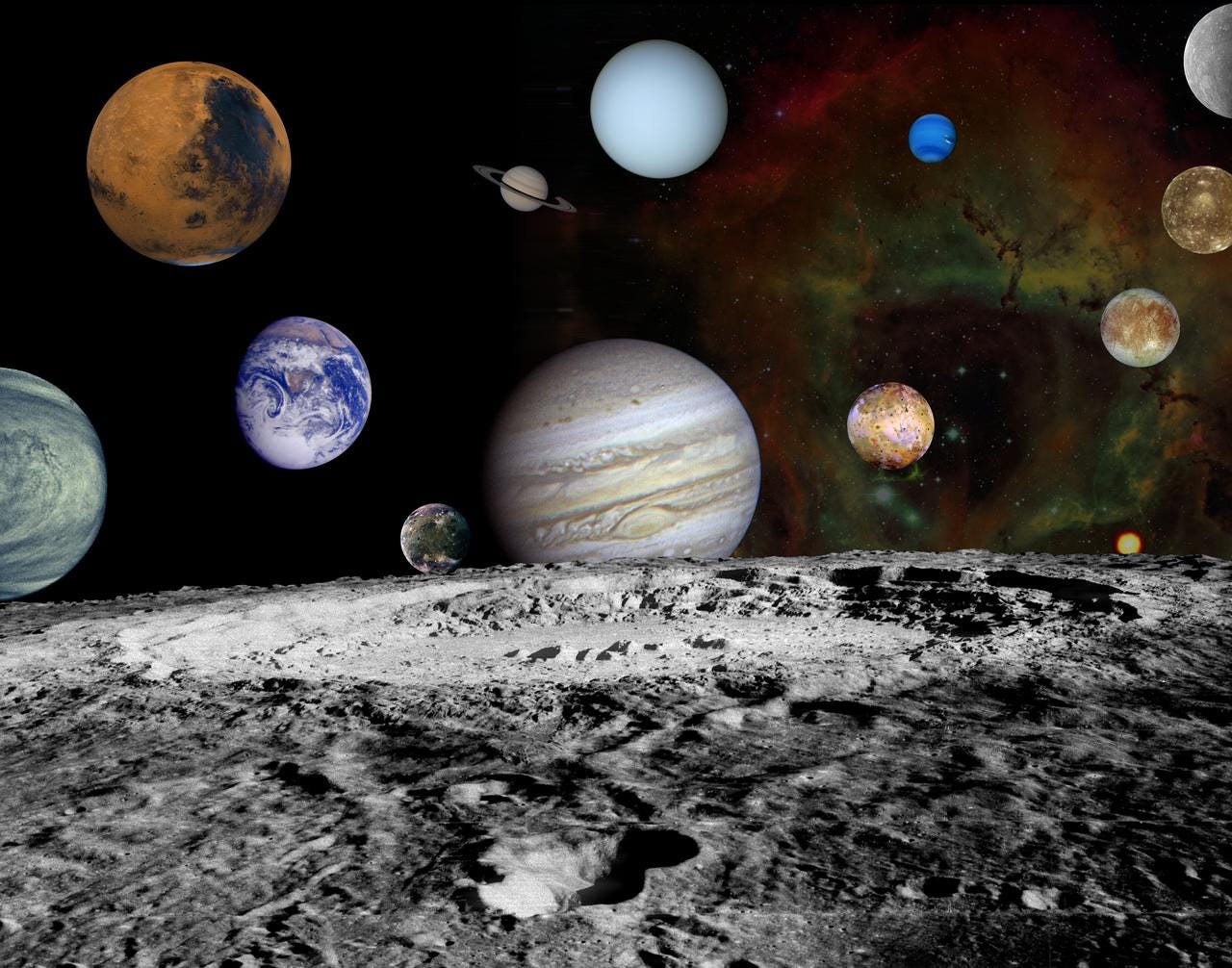
Imagine an infinite universe with infinite planets.
Are you doing it? It’s not too far-fetched; we have no way of knowing what is outside the observable universe, so there could be an arbitrarily large number of worlds besides our own. Even our own universe has about two-trillion galaxies by current estimates, so if you’d like you can replace “infinity” with that insane number.
But now imagine there are also infinite travelers visiting those infinite planets. Their exact origin doesn’t matter, just imagine a big pool of them in space, visiting the planets one by one.
Are you done imagining? Great, now we can pose our riddle:
With Infinite Travelers Visiting Infinite Worlds at Random, What Portion of Worlds are Expected to be Empty?
The key assumptions are that each traveler visits one world, and the two infinities (travelers and worlds) are of similar sizes.
In terms of hints, this is a simple issue of probability; the infinities are distractions.
Thinking about this simple problem reveals some fun details about how probabilities behave with large numbers, and we’ll use it to reveal an interesting insight about aliens.
Scroll down when you’re ready for my answer!
Starting with Buckets
Infinities are not so well-behaved, so let’s start with something a bit simpler to get our bearings.
100 balls in 100 buckets. I toss the balls at random into the buckets, one at a time. When I throw the first ball, the chances it goes into any given bucket is 1/100, or a 1% chance. By extension, the chances of any bucket not getting the ball is 99/100, or a 99% chance.
This chance is the same for the second ball. But, what are the chances of both the first AND the second ball both missing a given bucket? Well it’s an and statement, so we multiply the probabilities to 0.99^2, or 98.1%. Can you imagine how to extend this to 100 balls?
We can generalize this formula for X balls in X buckets. The chance of a given bucket being empty, which is equal to our expected portion of empty buckets, is this:
P = ((X-1)/X)^XIf we plot this in WolframAlpha we get this:

Notice the trend? We can take this and extrapolate to our original problem by taking the limit to infinity:
P = lim(X-> ± ∞){((-1 + X)/X)^X} = 1/e ≈ 0.367879Skipping some steps here, we see that in the infinite case, we expect 36% of worlds to be empty, even with infinite travelers.
But what does this tell us about the worlds that are visited?
Bonus Question: What is the Average Number of Visitors in the Subset of Visited Worlds?
This is a much simpler question, but with less intuitive result.
The average number of visitors per world is simply the number of travelers over the number of worlds, X/X, which is 1. In a vacuum, knowing nothing else about a planet in this scenario, you would expect one visitor.
But in the subset of worlds with at least one traveler, the average is equal to total number of travelers X divided by the subset of visited worlds, X*(1-0.367879).
(Subset Mean) = (Travelers)/(Visited Worlds) = X/(X*(1-0.367879))In other words, the average number of visitors per world, for the non-empty worlds, is not 1. It’s 1.58.
That means, in an infinite universe with infinite travelers, the moment you land on a planet, your best bet is that someone else is there with you.
Wrapping Up, What Does This Mean?
I personally am something of a skeptic about meeting other intelligent life in our universe, but if for argument’s sake we concede that life is very common, what would be the best way to find it?
We don’t need real infinities for this math to be relevant. The formula for empty worlds converges around 10 worlds, and we are well past that point. As for infinite travelers, there are 8.2 billion people on Earth alone, so if life is common in our universe, the numbers might very well add up to “close to even”.
But the surprising thing here is that venturing out into our hypothetical universe gives you similar odds of finding aliens as just looking at the planet you’re already on. So if aliens are a common thing in the universe, we might as well turn our telescopes inwards.
Because the math says they might already be here.

Yea...I get the math but this is a logic problem. If there are infinite travelers for infinite worlds every world will have a visitor because the visitors are infinite.