


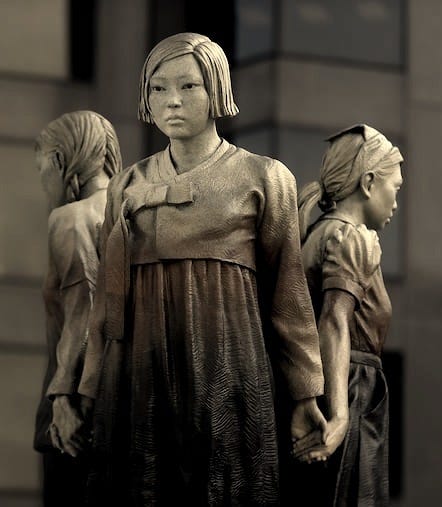
“Comfort women.” It was what the Japanese soldiers called us. The Japanese Army said rape was bad for community relations, it risked spreading diseases, and was bad for military discipline. But with comfort stations that could all be controlled. Civilized rape.
The echoes of American gunfire in the distance reverberated in Soon-hee’s ears.
They crawled through mud, half-wading in the waist-deep fish pools bordering Manila, concealed by new moon darkness and overgrown grasses. As light from the military camp faded behind them, Soon-hee should have felt relieved; instead, her anxiety only increased.
She mis-stepped, and was punished with a loud, audible CRACK .
From just ahead, Maria spun around, eyes furious. “You want to die!?” She hissed in broken Korean. At 18 years-old, Maria was just one year Soon-hee’s senior, but age wasn’t the only factor in her taking the lead. She had been part of the Hukbalahap — a Filipino guerilla resistance force — before getting caught and forced into service.
Their entire plan hinged on the fact that Maria had spotted a small boat a few times when the girls had been escorted down to the river to wash clothes. Hopefully, it would still be there. It needed to be.
Soon-hee winced, timidly apologizing. She was no freedom-fighter, but even she understood. If the soldiers heard and caught them, their punishment would be severe. A beating if they were lucky, death if they weren’t. But either way, they’d be taken back.
They had just snuck away a few hours prior. None of the others joined them in escape. “Too risky,” they had said. “Better to be a comfort woman,than a dead woman.”
Amidst the chaos of the ever advancing American assault, Maria had promised the Japanese wouldn’t notice a few missing girls. Soon-hee prayed she was right.
Anxiety now bleeding out of her ears, Soon-hee waded even more gingerly through the grass.
Soon-hee clutched a small chest close to her heart, a family antique, and the only belonging she dared bring from the camp. Inside were only a makeshift knife, a half-empty matchbox, and a small bundle of misshapen candles.
As if to fill the vacuum of silence between breaths, memories poured from the chest. Suddenly it was 1943 again, in Seoul, more than a thousand miles away. She felt the chill of the February frost on her skin. Her eyes were puffy, tear-stained and red from arguing with her Appa. It was the same argument as always. He was a candlemaker in a world that was discovering electricity. Soon-hee yelled that’s why they were poor. He said something about the value of bringing light by your own hands. Soon-hee called him crazy, and marched off to the Japanese Imperial Branch Office to accept a job as an office assistant. That was two years ago, and the last time she saw her father.
But it was a trap. The Japanese Army gave promises of money and careers, only to kidnap and ship women to camps on the front lines. They came from all over the empire: Korea — like Soon-hee, China, Taiwan, or the Philippines like Maria.
One woman even came from the Netherlands. Tall, with blonde hair and wide eyes. They couldn’t really communicate, but Soon-hee admired her. The woman snapped one day though, slapping a Japanese officer when he forced himself upon her too roughly. She was shot dead that day, and Maria started planning their escape that same night.
Soon-hee always regretted never learning the blonde woman’s name.
Maria grasped Soon-hee’s shoulder, shaking her from her memories. Soon-hee panicked momentarily, but relaxed when Maria pointed towards a nearby mangrove patch. There, concealed by the trees was a small dock, just as Maria promised.
Upon it lay their vessel of salvation. The small, military scouting ship, no larger than a skiff, sat overturned and abandoned. Maria let out a sigh of relief, almost betraying her young age.
Freedom was so close. Soon-hee rushed forward, momentarily forgetting caution. She tripped, falling into a deep pool. Instantly she was up to her shoulders, her eyes wide with fear.
It was a loud splash. Far too loud.
Soon-hee’s heart nearly burst from her chest, and her eyes darted anywhere and everywhere looking for danger. Maria dove into the water and gripped over Soon-hee’s mouth, her fingers squeezing hard against Soon-hee’s teeth.
With her free hand, Maria silently pointed towards two lights ambling towards them. Japanese soldiers carrying rifles and lanterns. Were they just on night patrol?
Or did they hear?
As the light got closer, Maria signalled to take a breath, and the girls submerged. Soon-hee counted the seconds. 10… 15…30. Her lungs burned. She squeezed her knees. It was that same horrible, suffocating feeling she felt every night, when unfamiliar bodies weighed on her chest. She almost gave in, but Maria gripped her hand and held tight, sharing her strength. Unable to know if the soldiers would be waiting above, every moment underwater counted.
They held so long, Soon-hee was sure she’d drown. Until finally, Maria pulled up and they breached the surface of the water. Soon-hee desperately suppressed her need to cough, only allowing herself the tiniest sips of air. Blessedly, when her vision cleared, the lights were gone. The soldiers hadn’t heard.
Next to her, Maria closed her eyes, taking deeper breaths, hands settling on her pregnant belly.
Soon-hee reached to comfort her. “Are you ok? Is your-?”
Maria scowled, slapping Soon-hee’s hand away. “I’m fine. We need to keep moving.”
They hurried down to the dock, working swiftly, silently, and in near total darkness. They flipped the ship, and as quietly as they could, dropped it into the water to climb in. They dared not operate the motor for fear of the sound it would make. Instead, they each grabbed an oar strapped to the inside of the hull, and pressed out into the water.
Soon, the shore was a thin line in the distance, and at long last, Soon-hee’s anxiety dropped. From here, they hoped to reach open water — far out enough to avoid detection — then drift south to the other side of Manila Bay to where Maria could make contact with the Hukbalahap.
Soon-hee opened her small chest, feeling for the candles. Lumpy and misshapen, they bore no scents, colors, or artistic designs. But for Soon-hee they were precious treasures, made by her own hands with the paltry materials she could scrounge for. A gift for Appa, to show how sorry she was. They represented hope. A hope that, maybe, her family would take her back despite the shame she carried.
All around, the glass water of the bay reflected the countless stars above. A tiny ship with only two passengers, bathed in twinkling scintillations.
Maria broke the silence with a low “Fuck,” spoken in her native tongue.
Soon-hee’s fleeting sense of relief evaporated instantly. She snapped back to look at her friend, but Maria wasn’t looking at her, or even on the horizon.
She was looking at the pool of water growing at her feet.
Nausea crashed over Soon-hee as it dawned on her. Of course there was a reason that ship was abandoned.
The pair scrambled to their knees to find the source of the water. “Found it!” Maria gasped, and pressed her hand against it, attempting to stymie the leak.
The water kept rising.
To their dismay, there wasn’t one single hole. Instead, little cracks, barely noticeable, leaked water from all over the ship’s hull. The water wasn’t remarkably fast, but it was constant, and it was coming from everywhere.
The two girls tore off their outer garments, pressing them against the sides of the hull. But water quickly soaked through the fabric, continuing to seep in.
Desperately they tried bailing the water out with their bare hands. But it wasn’t nearly enough, and Soon-hee’s hands were trembling so badly she could hardly hold water.
The water was starting to pour in faster.
It was all too much. Soon-hee’s throat swelled, and she didn’t know whether she needed to breathe or to throw up. Her mind flashed back to less than an hour before, to that sensation of drowning. Suddenly she was a child again, feeling the unstoppable tidal wave of tears that wells up just before a meltdown.
It started as a whimper, but Soon-hee could feel it quickly growing into a wail. But before the sound escaped her lips — her world spun with stars and blackness.
Her head slammed hard against metal, hair submerged in the pool of water. Dazed, she looked up to see Maria on top of her, one hand gripping Soon-hee’s neck, the other holding a knife to her throat.
“You scream, you’ll kill us both.” Maria snarled.
Starkly sobered up, Soon-hee gulped, feeling the knife tighten against her skin. She choked back her tears, and met Maria’s eyes. She was crying too.
The knife retreated, and Maria helped Soon-hee up. Maria sat back down in her seat. Soon-hee slipped back into hers as well.
The water was up to their ankles now.
Almost choking on their vile taste, Soon-hee whispered the words she hated most. “We could turn back.”
Maria’s eyes grew wild. “How dare you! Even if we did manage to sneak back in, we’d be put back to work! I refuse.”
“Better a dead woman than a comfort woman?”
“Exactly.” Maria’s eyes were cold.
Death by drowning, or returning to the hell that was their life in camp. Were those truly their only two options?
The water had reached their knees.
Soon-hee looked back to the shore, barely visible now. Ahead was only darkness… but there, on the opposite horizon, a shadow moved along the water. Another ship?
Was there a third option?
Soon-hee pointed at the shadow, “There! What do you think? Japanese or American?”
“Not sure. But if it’s Japanese…I’m not going back.” Maria held up her knife.
One last gambit then. Water that would definitely kill them, Americans who might, and if it was Japanese… they’d do it themselves.
Soon-hee nodded.
“OK. How should we signal them?” Maria asked.
Soon-hee picked up her chest, cradling it in her arms. She opened it, the bundle of candles still inside. They were intended to be a gift for her Appa, but perhaps, they were his gift to her. To bring light by her own hands.
“Thank you.” She whispered, holding the candles close, and recited a silent prayer. Then she struck one of the matches, and held the flame to each of the candles, casting a soft glow over their sinking ship.
Then, they waited. Candles in one hand, knife in the other. And the water rose.
The shadow grew. The unknown ship had noticed them.
Soon-hee tensed.
Maria lifted the knife to her chest.
Soon-hee followed suit, hand quivering.
The shadow loomed close enough that she could make out its silhouette, but not the flag.
Her hand tightened, the weight of the knife burning against her chest.
Memories flashed. She was there again, experiencing the hellish nights when it seemed the lines of soldiers would never end. The scars and bruises across her body burned anew. Never again.
The two girls locked eyes. United resolution. Soon-hee prepared to plunge.
But then, a voice cut the silence. Elderly and soft, not unlike her Appa’s. And not Japanese, or English. Tagalog?
Maria shot up, eyes-wide.
“He’s a fisherman.” Maria translated dumbfoundedly. “He asked, ‘What the hell are two girls doing in the middle of Manila Bay at 3AM?’”
Soon-hee almost laughed from pure shock. She took Maria’s hand, and hollowly climbed aboard the fishing boat, dropping her belongings in the process.
The knife sank deep below, along with their ship. The candles floated, flickering in the water.
The world ahead of them was still dark. But one day, perhaps, Soon-hee would find light again.
Words From the Author
I wrote this story for the NYC Midnight Short Story Contest Round 1, with the prompts “Genre: Suspense, Subject: A Sinking Ship, Character: A Candlemaker.” And I am humbled and proud to have found out it made first place in its group! I’ll share my judge’s feedback and our writing process in a separate post, but I thought I’d talk about a bit of the history part now.
If you’ve read some of my other stories, you might have noticed the pattern in that I like to write historical fictions around WWII. It’s a sort of personal anthology I’ve been trying to build, telling stories highlight the strength of young people in WWII, particularly in the Pacific. So unlike most of our short story competitions, where we build a story from complete scratch based on the prompts, I had actually been wanting to tell a story like this for some time.
However, the idea I had didn’t extend beyond wanting to write a story about someone attempting to escape a comfort woman station. So to determine how to fit a “sinking ship” and "candlemaker,” I spent a lot of time researching and reading accounts of survivors, technology in WWII, the kinds of boats that were available, and so on. It was through this process that Manila Bay became the location, and Soon-hee’s father became a candlemaker.
It was also through the research process that I learned many details I thought were important to include in the story. For example, I was familiar with Korean women being subjected to becoming comfort women, but I had no idea just how widespread the system was. It also broke my heart to learn just how poorly documented so many stations were (for a myriad of reasons), so SO many women’s stories have just been lost to history. This is what inspired the unnamed woman from the Netherlands, unknown but unforgotten.
Soon-hee and Maria may be fictional characters, but their story reflects real human history and experiences. If you would like to learn more, I highly recommend starting with the “Digital Museum: The Comfort Women Issue and the Asian Women’s Fund.” It is not an easy read, but I think it is an important one.
This was a difficult piece to work on. When trying to tell stories about sensitive, graphic subject material it becomes a tightrope where we want to simultaneously give an accurate description of a horrific experience while not allowing the tone to shift into horror.
The events being described are, in reality, even worse and more tragic than our depiction of them. But we live in an era of slasher fiction, true crime, and shock horror where gruesome imagery is reinterpreted by modern eyes as cheap stimulus. In that context, it becomes difficult to tell a story like that of the Korean comfort woman, who is subjected to the reality of human evil that these genres seek to parody or commercialize.
George really gets around this by keeping the story grounded in the characters’ emotions and experience. I personally pushed for more graphic content in the story, wanting to avoid “softening” the depiction or converting real life tragedy into adventure fiction. But ultimately, I think George’s more subtle approach of understating the physical violence allowed the characters to shine beyond their capacity as victims.